Why Is It The Sky Is Blue

Hey there, curious mind! Ever looked up at the sky and wondered, "Why the heck is it blue?" Well, grab a seat, 'cause we're about to dive into a fun little science lesson that...
Hey there, curious mind! Ever looked up at the sky and wondered, "Why the heck is it blue?" Well, grab a seat, 'cause we're about to dive into a fun little science lesson that's as easy on the brain as a sunny day is on the eyes.
Let's Talk Light
First things first, we need to chat about light. You know, that thing that makes your plants happy and your cat's eyes glow in the dark. Light is basically a bunch of tiny particles called photons zooming around at super speed. And guess what? These little speedsters come in all sorts of colors, from red to violet, creating what we call the visible light spectrum.
Now, here's where things get interesting. When light hits something, it can either be absorbed, reflected, or pass right through. And you know what? Our dear old atmosphere, that thin layer of gases surrounding our planet, is a bit of a light hog. It loves to absorb light, especially the shorter wavelengths like blue and violet.
Must Read
Enter Rayleigh Scattering
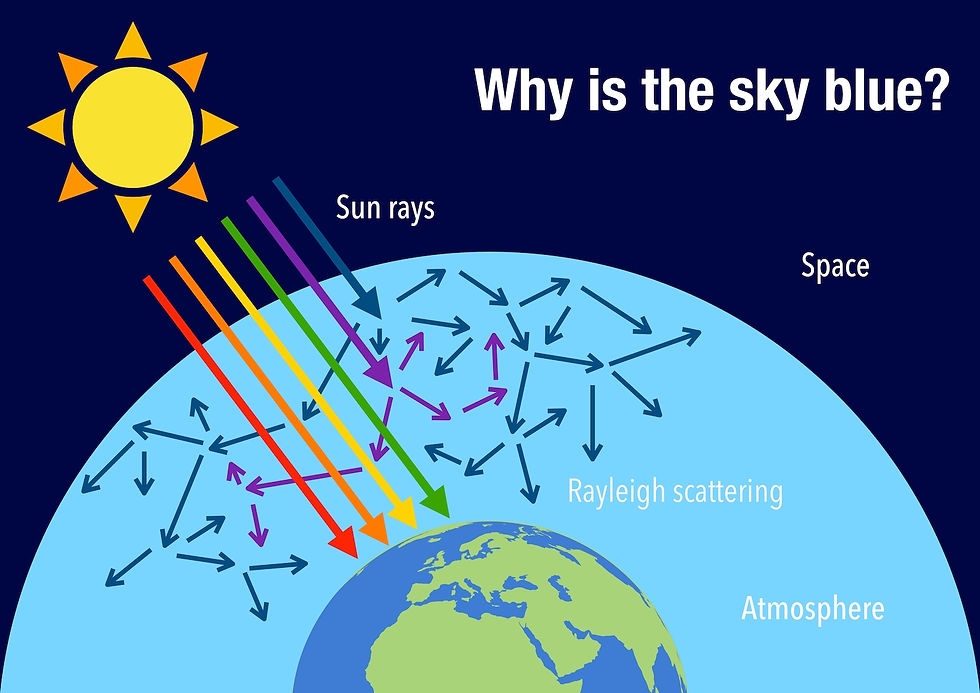
Alright, so we've got light zooming in from all directions, and our atmosphere is busy soaking up those shorter wavelengths. But here's the kicker: when light hits tiny particles in the air, like nitrogen and oxygen molecules, it gets scattered in all sorts of directions. This, my friend, is called Rayleigh scattering, named after the British physicist Lord Rayleigh who discovered it. Isn't science just full of fancy names?
So, light is bouncing around like a pinball, and our eyes are picking up on the different colors. But here's the thing: blue and violet light get scattered more than other colors because they travel in shorter, smaller waves. It's like they're playing a game of pinball, and they're the tiny, agile players that can weave in and out of the crowd.
 Why Is The Blue Sky Blue at Samantha Atherton blog
Why Blue, Not Violet?
Alright, so we've established that blue and violet light are the pinball wizards of the light spectrum. But why do we see blue, and not violet? Well, that's because our eyes are more sensitive to blue light, and there's also more blue light around to begin with. Plus, some of that violet light gets absorbed by the atmosphere, leaving blue as the reigning champion of the sky's color palette.
Pretty neat, huh? All this time, you've been looking at the sky, and it's been a big ol' light show, with blue taking center stage. Now, you might be thinking, "But what about sunsets? The sky's all red and orange then." Great question! That's because when the sun is low in the sky, its light has to pass through more of Earth's atmosphere. All that scattering means the shorter blue and violet wavelengths get absorbed, leaving the longer red and orange wavelengths to paint the sky with their warm hues.
 Why the Sky is Blue - Rayleigh Scattering | BioRender Science Templates
Blue Skies Ahead
So there you have it, the not-so-secret reason behind the sky's blue appearance. It's all about light, tiny particles, and a bit of physics magic. Next time you look up at the big blue canvas above, remember it's a constant reminder of the amazing things happening right in front of our eyes, every single day.
And hey, if you ever find yourself feeling down, just look up at that blue sky and remember: no matter what's going on, there's always a little bit of light and wonder up there, waiting to brighten your day. Isn't that something worth smiling about?
